Google Gemini Hits 1 Billion Monthly Users: Inside the 2026 AI Assistant Race
The AI assistant race just got a new scoreboard. On August 11, 2026, Google announced that its Gemini app has crossed 1 billion monthly active users — a milestone that arrived faster than any product in the company’s 28-year history. It’s the 14th Google product to ever reach that scale, joining Search, Gmail, Android, Maps, Chrome, Play, and YouTube in a club almost no company builds even one member of.
For a product that looked completely different just two years ago, hitting a billion users in roughly a year of aggressive growth says as much about the pace of the AI race as it does about Google’s execution. But the number itself isn’t the most interesting part of this story. What a billion people are actually doing with an AI assistant every month — and what that tells us about where consumer AI is headed next — is.
Quick facts
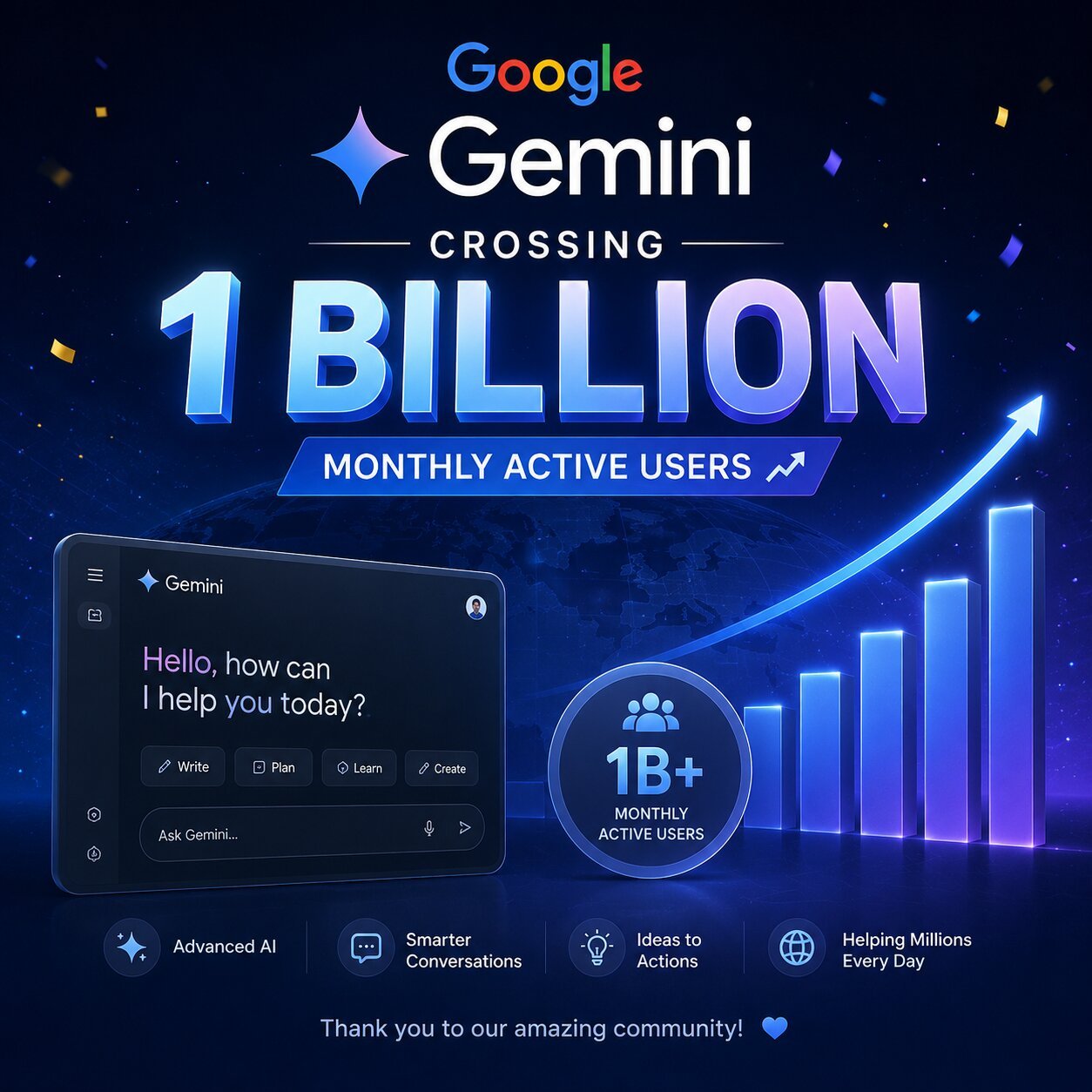
- Gemini passed 1 billion monthly active users on August 11, 2026 — Google’s fastest-growing product ever.
- ChatGPT reached 1 billion monthly users in June 2026 and 1 billion weekly users by August.
- 63% of Gemini users now interact with it by voice rather than typing.
- The app generates 150+ million images per day and automates tasks across 40+ connected apps.
- The milestone lands amid a major leadership reshuffle inside Google DeepMind.
What Google Actually Announced
CEO Sundar Pichai shared the news himself, calling Gemini the company’s “fastest-growing product ever.” The billion-user figure covers people who use the standalone Gemini app and web interface specifically. It doesn’t include the separate audience using Gemini-powered AI Overviews inside Google Search, which has independently passed a billion monthly users of its own, or the millions of people who touch Gemini features inside Gmail, Docs, and the rest of Workspace without ever opening the app. Add all of that together, and Gemini’s real footprint across Google’s ecosystem is considerably larger than the headline number suggests.
The timing wasn’t an accident either. The announcement landed one day before Google’s “Made by Google” hardware event on August 12, where the company leaned further into Gemini as the connective layer across Pixel phones, watches, and other devices — a sign that Google increasingly sees the assistant less as a standalone chatbot and more as the operating layer for everything it builds.
The Road to a Billion Users
Gemini’s growth curve is arguably the more striking story than the milestone itself. By Google’s own numbers, the app climbed from around 400 million monthly users in May 2025 to roughly 900 million a year later, then added another 100-plus million in a matter of weeks, jumping from the 950 million reported on Google’s Q2 earnings call to over a billion by mid-August. That kind of acceleration is unusual even by Big Tech standards, and it lines up with a broader shift Google flagged: daily active users reportedly tripled over the past year, meaning the app isn’t just adding new accounts; it’s converting casual visitors into habitual, daily users.
Much of that curve is inseparable from distribution. Android ships with Gemini set as the default assistant, which routes a huge number of users to the app without them ever searching for it or actively choosing to download it — a structural advantage no competitor operating outside a major mobile OS can match. That doesn’t make the growth fake, but it does mean the number reflects platform reach as much as pure product pull.
Gemini vs. ChatGPT: Monthly Isn’t the Same as Weekly
Every Gemini milestone gets measured against ChatGPT, and this one is no exception — but the comparison is messier than most headlines suggest. OpenAI’s ChatGPT reached 1 billion monthly active users back in June 2026, about two months ahead of Gemini, and had already crossed the tougher benchmark of 1 billion weekly active users by the time Google made its announcement. Monthly and weekly active users aren’t interchangeable metrics: a weekly figure implies deeper, more habitual engagement, since it requires people to return to the product roughly every seven days rather than once a month.
So while Gemini and ChatGPT are technically both “billion-user products” now, they got there on different tracks, and the totals aren’t quite apples-to-apples. What’s arguably more telling than the raw scale is that Google didn’t disclose how many of those billion users actually pay for anything — a gap that matters more than user count if the real competition in AI is about turning usage into revenue. Reports also suggest ChatGPT’s growth has cooled somewhat even as it holds the largest share of the standalone chatbot market, while Gemini keeps gaining ground by riding Android, Chrome, Search, and Workspace distribution all at once.
How People Are Actually Using Gemini
Beyond the topline number, Google shared usage data that says more about where AI assistants are headed than the user count alone does.
- Voice-first is the new normal: 63% of users now talk to Gemini instead of typing, and that share climbs even higher among busy parents, who are about 43% more likely to use voice for everyday tasks.
- Visual interaction is rising fast: one in five Gemini Live sessions now involve sharing a camera feed or a screen rather than voice alone — especially popular for DIY fixes and real-time homework help.
- Students lean on attachments: 38% of school-related requests include an uploaded file, from worksheets to textbook photos.
- The app generates more than 150 million images per day and can complete automated tasks — like booking a ride or reserving a table — across more than 40 connected apps.
Put together, these numbers describe an assistant that’s drifting away from being a search-box replacement and toward something closer to a general-purpose interface for getting things done, in whatever format is fastest in the moment: talking, showing, or uploading.
A Leadership Shake-Up Behind the Scenes
The milestone also arrives amid real turbulence inside the team building Gemini. Just a week before the announcement, Google restructured its AI division, and Demis Hassabis, the Nobel Prize-winning head of Google DeepMind, stepped back from day-to-day management of the lab responsible for Gemini’s underlying models. Several senior researchers have also departed recently, including longtime engineering leader Jeff Dean. Compounding the pressure, Gemini 3.5 Pro, the next flagship model originally targeted for a June release, still hasn’t shipped, even as rival labs have released models many consider more capable, particularly for coding and computer-use tasks.
In other words, Google is celebrating a major consumer win at the exact moment its research organisation is navigating one of its most disruptive stretches in years — a tension worth watching as the AI race enters its next phase.
What This Means for Businesses and Everyday Users
For everyday users, the billion-user milestone is really a signal about defaults: if you own an Android phone, there’s a good chance Gemini is already sitting one tap away, whether you went looking for it or not. That’s worth knowing if you’ve been comparing AI tools and assumed you needed to actively choose and install one — increasingly, the assistant may already be waiting on your device.
For businesses, the usage numbers hint at where product design is heading. Voice-first interaction, live camera and screen sharing, and file-heavy workflows aren’t niche features anymore; they’re becoming the default way a meaningful share of a billion-person user base interacts with AI. Companies building customer-facing tools, support bots, or internal AI workflows may want to rethink interfaces that still assume a text box is the primary input method. The growth of task automation across dozens of connected apps also points toward a near future where AI assistants are expected to complete actions, not just answer questions — which raises the bar for what “good enough” AI support looks like for any company competing in this space.

Conclusion
Crossing a billion monthly users is a genuine milestone for Gemini and a clear sign that consumer AI has moved well past its novelty phase — this is now mainstream infrastructure that hundreds of millions of people rely on daily, not a chatbot people try once out of curiosity. But the number alone doesn’t settle the bigger competition. ChatGPT still holds the harder weekly-engagement benchmark, Google hasn’t said how many Gemini users actually pay for anything, and the team building Gemini’s next model is navigating a major leadership transition in real time.
What’s clearer than “who’s winning” is the direction everything is moving: AI assistants are becoming voice-first, visual, action-taking tools woven into operating systems rather than apps people separately choose to open. That shift, more than any single user count, is the trend worth tracking through the rest of 2026.
Frequently Asked Questions
How many users does Google Gemini have as of August 2026?
As of August 11, 2026, Google says the Gemini app has surpassed 1 billion monthly active users. That figure doesn’t include people who use Gemini through Google Search’s AI Overviews or through Workspace apps like Gmail and Docs.
Is Gemini bigger than ChatGPT?
Not exactly — the two aren’t measured the same way. ChatGPT passed 1 billion monthly users in June 2026 and had already reached 1 billion weekly active users by August, a tougher benchmark that reflects more frequent use. Gemini reached 1 billion monthly users in August but hasn’t disclosed a weekly-user figure.
Why is Gemini growing so fast?
A combination of factors is driving it: Gemini is the default assistant on Android devices, so a large share of its growth comes from built-in distribution rather than users actively seeking it out. Google has also woven Gemini into Search, Chrome, and Workspace, giving it far more entry points than a typical standalone app.
What are people mainly using Gemini for?
Google’s usage data shows voice is now the primary way people interact with Gemini (63% of users), followed by visual tasks like camera and screen sharing, file uploads (especially among students), image generation, and automated tasks such as booking rides or restaurant reservations across more than 40 connected apps.
Did Google reveal how many Gemini users pay for the service?
No. Google’s announcement highlighted total monthly active users and usage patterns but did not disclose subscriber or paying-user numbers, an omission several outlets flagged as notable.
What’s happening with Google DeepMind’s leadership?
Around the same time as the milestone, Google restructured its AI division. Demis Hassabis stepped back from day-to-day management of DeepMind, and several senior researchers, including longtime engineer Jeff Dean, have left. Google’s next flagship model, Gemini 3.5 Pro, has also been delayed past its original June 2026 target.
Thank you for reading
Buy Web Hosting at an affordable price: Buy Now.
If you want to build your website at an affordable price, contact www.nextr.in
Read this: How AI is Changing Education
How Gemini’s fastest-ever climb to a billion users compares to ChatGPT, what people are actually doing with it, and what it signals for AI in 2026.