The Complete Guide to Growing Your Business Online
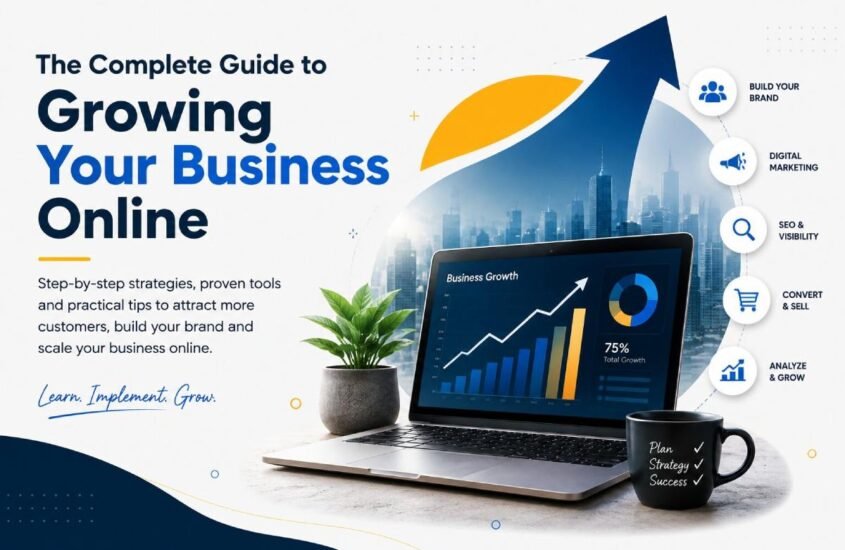
Growing a business online in 2026 looks different than it did even two years ago. Search engines increasingly answer questions directly instead of just listing links, short-form video has become a primary discovery channel, and AI tools have changed both how customers shop and how businesses market. The fundamentals of building a real online presence haven’t disappeared, but the playbook for winning attention, trust, and sales has been rewritten around them.
This guide walks through everything you need to grow your business online today: the foundational pieces every business needs, the SEO strategies that still work, the newer skill of showing up inside AI-generated answers, and the content, social, and advertising tactics that turn visibility into revenue. Whether you’re launching a new business or scaling an existing one, treat this as your working checklist.
What you’ll learn
- How to build a website and brand foundation that supports long-term growth
- Why AI Overviews and chat-based search are changing SEO, and what to do about it
- Which content and social formats actually drive traffic and sales in 2026
- How to use paid ads, email, and AI tools without wasting your budget
- The metrics that actually tell you whether your strategy is working
Step 1: Build a Strong Digital Foundation
Every online growth strategy sits on top of the same foundation: a fast, mobile-friendly website with a clear message about who you help and how. Before spending a rupee or a dollar on marketing, make sure your site loads quickly on mobile, states your value proposition in the first few seconds, and makes it obvious what you want a visitor to do next, whether that’s booking a call, making a purchase, or signing up for a list.
Consistency matters as much as quality. Your business name, logo, colours, and tone should look and feel consistent across your website, social profiles, and Google Business Profile. For local or service-based businesses, an optimised Google Business Profile with accurate hours, photos, and categories is often the single highest-leverage listing you can maintain, since it directly feeds local search and maps results.
Step 2: Win at SEO — and the New AI Search Layer
Classic SEO fundamentals still matter: researching the keywords your customers actually search for, writing clear on-page titles and headers, fixing technical issues that block crawling, and earning backlinks from credible sites. None of that has gone away.
What’s new in 2026 is that a growing share of people research and shop by asking an AI assistant instead of scrolling through ten blue links. Google’s AI Overviews, AI Mode, ChatGPT, and Perplexity now answer many queries directly, often before a user clicks anything. This has given rise to answer engine optimisation (AEO), sometimes called generative engine optimisation (GEO): writing content so that AI systems can find it, trust it, and cite it inside their answers.
- Lead with a direct, quotable answer to the question in your heading, then support it with detail.
- Structure content with clear headers, short paragraphs, and lists so it’s easy for both readers and AI systems to parse.
- Back claims with specific numbers, examples, or sources instead of vague statements.
- Build topical authority by thoroughly covering a subject over multiple pieces of content, not just one keyword at a time.
Treat AEO as a layer on top of good SEO, not a replacement for it. The businesses gaining visibility right now are the ones showing up both in traditional rankings and inside AI-generated answers.
Step 3: Create Content That Compounds
Paid ads stop working the moment you stop paying. Good content keeps working long after you publish it. Blog posts, guides, and videos that answer real questions your customers ask keep attracting traffic, building trust, and generating leads for months or years, especially once a site has built up topical authority in its niche.
You don’t need to create everything from scratch every time. One well-researched guide can be repurposed into social captions, an email newsletter, a short video script, and several smaller posts, multiplying the return on the time you put into it. The goal is to build a body of content that thoroughly answers the questions your ideal customers are asking, in the format they prefer to consume.
Step 4: Meet Customers on Social Media
Short-form video, on Instagram Reels, YouTube Shorts, and similar formats, remains one of the fastest ways to reach new people who’ve never heard of your business. Social platforms also increasingly support shopping directly inside the app, shortening the distance between discovery and purchase.
The bigger mistake most businesses make isn’t picking the wrong platform; it’s trying to be active on all of them at once. It’s far more effective to post consistently on the one or two platforms where your actual customers already spend time than to post sporadically everywhere.
Step 5: Use Paid Advertising Strategically
Paid advertising is the fastest way to generate leads while your organic channels build momentum. Search ads work well for capturing people who are already looking for what you sell, while social ads are better suited to building awareness and retargeting people who’ve already visited your site but haven’t converted yet.
Start with a small, defined test budget, track which ads actually lead to sales rather than just clicks, and scale up only what’s proven to work. Paid ads should support your organic growth, not replace it, since costs rise the moment you rely on advertising alone.
Step 6: Turn Visitors into Customers With Email
A website visitor who doesn’t convert today isn’t a lost cause if you’ve captured their email address. A simple welcome sequence, a cart-abandonment reminder for ecommerce stores, and a regular newsletter with genuinely useful content can turn one-time visitors into repeat customers at a fraction of the cost of acquiring a new lead through ads. Retaining and re-engaging existing customers is consistently cheaper than acquiring new ones, which makes email one of the highest-ROI channels available to small businesses.
Step 7: Build Trust With Reviews and Social Proof
Reviews, testimonials, and case studies do double duty: they reassure human visitors, and they give AI search tools concrete evidence to cite when recommending a business. Actively ask satisfied customers for reviews on Google and relevant platforms, and feature real testimonials and user-generated content on your website and social channels rather than generic stock claims. In a marketplace where people can quickly cross-check claims through an AI assistant, visible, specific proof matters more than polished marketing copy alone.
Step 8: Let AI Tools Support Your Team
AI tools can genuinely speed up growth work: drafting first versions of content, powering customer-service chatbots, personalising product recommendations, generating ad copy variations, and summarising analytics. Used well, they free up your team to focus on strategy and judgment calls a tool can’t make.
Used carelessly, they can also flood your website with generic, interchangeable content that neither readers nor search algorithms trust. The businesses getting the most value from AI treat it as a drafting and research assistant, then have a real person edit for accuracy, brand voice, and the specific details that make content genuinely useful rather than generic.
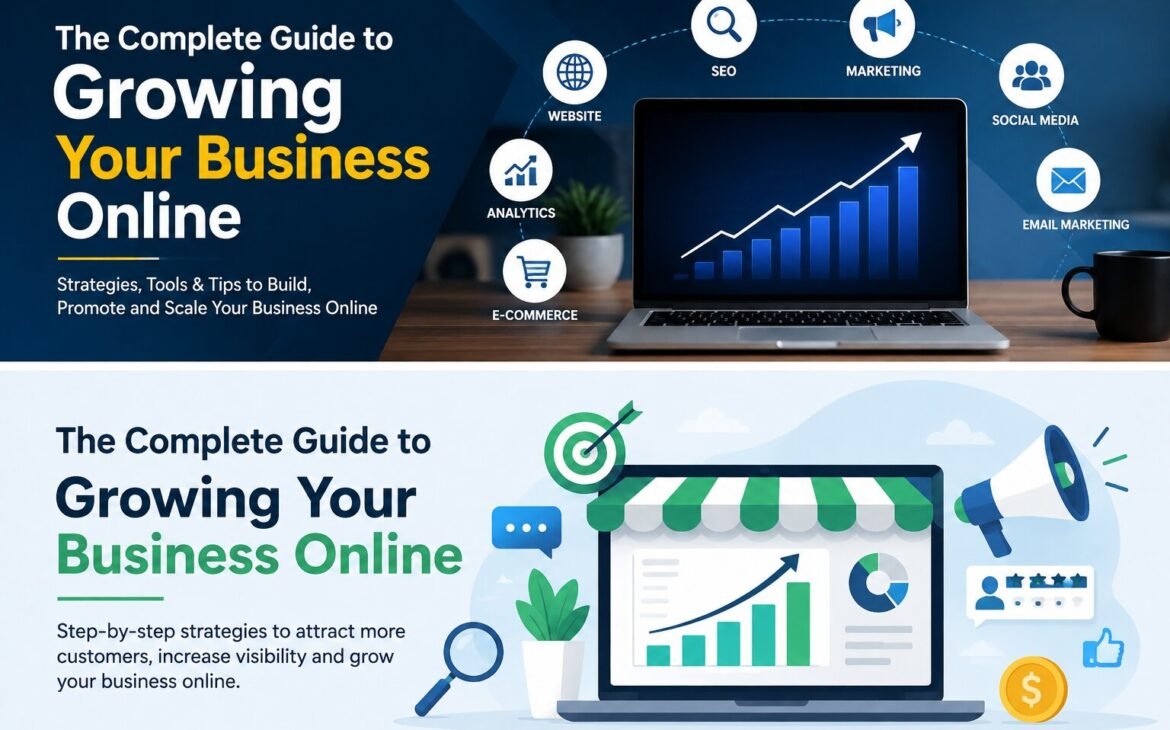
Step 9: Track What Actually Matters
It’s easy to get distracted by vanity metrics like likes, followers, or impressions. What actually indicates growth is whether your traffic converts into leads, sales, or sign-ups, and at what cost. Set up basic conversion tracking through Google Analytics and your ad platforms, review it monthly, and be willing to cut channels that generate activity without generating revenue.
Common Mistakes to Avoid
- Trying to be active on every platform instead of doing one or two channels consistently well.
- Treating SEO as a one-time project instead of ongoing, iterative work.
- Ignoring page speed and the mobile experience, which quietly costs conversions every day.
- Publishing generic AI-written content with no editing, fact-checking, or brand voice.
- Running paid ads without tracking which ones actually lead to sales.
- Having no clear call-to-action, leaving visitors unsure what to do next.
Conclusion
Growing a business online in 2026 isn’t about chasing every new trend; it’s about stacking a handful of fundamentals: a solid website, real SEO and AI-search visibility, genuinely useful content, the right one or two social channels, smart advertising, and consistent follow-up through email. The businesses winning right now are the ones treating their online presence as an ongoing system rather than a one-time project.
Start with your foundation, layer in one channel at a time, measure honestly, and let AI tools support your team’s judgment rather than replace it. None of these steps is complicated on its own; the compounding result of doing all of them consistently is what actually moves the needle.
Frequently Asked Questions
How long does it take to grow a business online?
Most businesses start seeing meaningful traction from SEO and content within 3 to 6 months, while paid ads and social media can produce faster, shorter-term results. Real compounding growth, where your online presence keeps generating leads with less ongoing effort, usually takes 6 to 12 months of consistent work.
What is the most important thing for growing a business online?
There’s no single silver bullet, but a fast, mobile-friendly website paired with genuinely useful content is the foundation everything else builds on. Without that in place, ads, social media, and SEO all have less to convert.
What is answer engine optimisation (AEO), and does my business need it?
AEO is the practice of structuring content so AI tools like Google AI Overviews, ChatGPT, and Perplexity can find, trust, and cite it when answering people’s questions. It’s becoming more important because a growing share of people now get answers directly from AI assistants instead of clicking through search results, making it a meaningful growth channel alongside traditional SEO.
Should a small business be on every social media platform?
No. It’s more effective to post consistently on the one or two platforms where your actual customers spend time than to spread thin, sporadic effort across five or six platforms.
Is paid advertising necessary to grow a business online?
Not necessarily, especially early on, but it can speed up results while organic channels like SEO, content, and social media build momentum. Many businesses use a mix: paid ads for immediate leads and organic channels for long-term, lower-cost growth.
How much should a small business budget for online marketing?
There’s no universal number, but many small businesses allocate somewhere around 5 to 10% of revenue to marketing, split across their website and SEO foundation, some paid advertising, and content or social media efforts. The right split depends on your industry, margins, and growth stage.
Thank you for reading
Buy Web Hosting at an affordable price: Buy Now.
If you want to build your website at an affordable price, contact www.nextr.in
Read this: How AI is Changing Education