How to Start an E-commerce Business in 2026: A Complete Beginner’s Guide
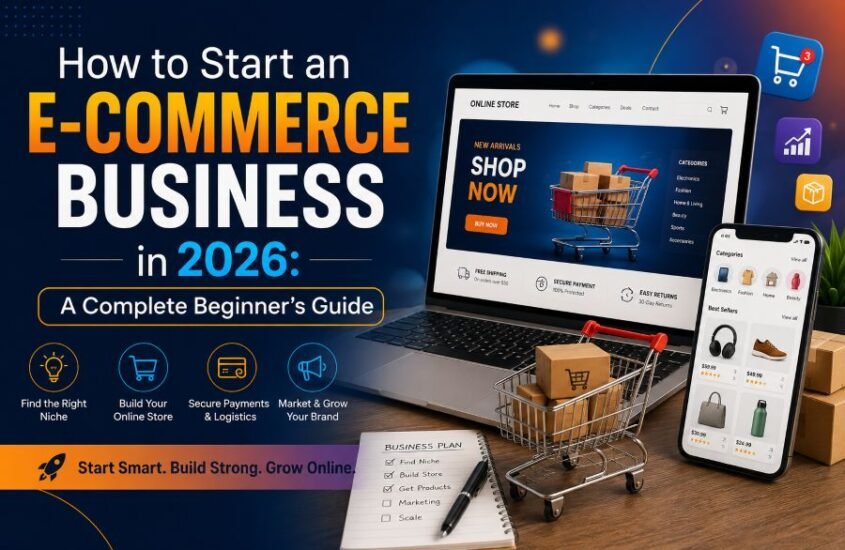
E-commerce keeps changing how people find, compare and buy products. In 2026, launching a shop is easier than ever, but success needs more than just a website and product uploads. Entrepreneurs have to decide on a niche, find reliable suppliers, build a mobile‑friendly e‑commerce website, offer secure payment options, use effective digital marketing and create a customer‑focused plan.
India’s e‑commerce opportunity remains strong with more people shopping and a robust digital‑payment system. UPI has become a part of India’s digital commerce ecosystem, while AI is being used more for recommendations, customer service, automation and personalised shopping experiences.
If you are planning to start an e‑commerce business in 2026, this guide explains the steps from choosing a business idea to launching and growing your online store.
Why Start an E-commerce Business in 2026?
The e‑commerce industry is becoming more competitive. It also offers chances for businesses of all sizes. You can start with a product category and slowly grow as your customer base expands.
Mobile commerce, UPI payments, AI‑powered recommendations, personalised marketing and omnichannel selling are some of the trends shaping online retail in 2026. India also continues to see digital‑commerce growth beyond major metropolitan areas, creating chances for businesses targeting tier‑2 and tier‑3 markets.
For entrepreneurs, an e‑commerce business can offer advantages such as:
Access to customers beyond your market
Lower entry barriers compared with traditional retail
Flexible business models
Multiple digital marketing channels
Ability to track customer behaviour and sales
Opportunities to build a recognisable brand
However, profitability depends on choosing the right products, controlling costs, providing excellent customer service and continuously improving the shopping experience.
Steps to Start an E-commerce Business in 2026
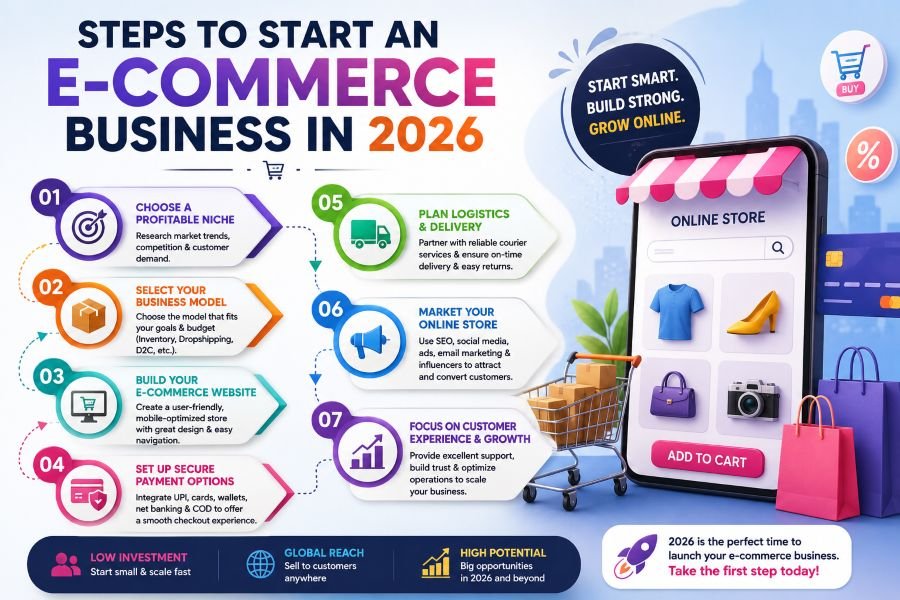
1. Choose a Profitable Niche and Product
The first step is deciding what you want to sell. Instead of trying to sell everything, consider starting with a specific niche. Examples include fashion accessories, beauty products, home décor, fitness products, electronics accessories, customised gifts, pet products or specialised B2B products.
Research your target customers before investing in inventory. Study competitors, pricing, product demand, customer reviews and potential profit margins.
A good product should ideally solve a problem, satisfy a need or offer a clear reason for customers to choose it over alternatives.
2. Select Your E-commerce Business Model
There are ways to operate an online store in 2026. You can. Keep your own inventory, work with manufacturers, use dropshipping, sell customised products or create a direct‑to‑consumer (D2C) brand.
Your business model will affect your investment, inventory requirements, delivery process, profit margins and customer experience.
For beginners, starting with a product range can make inventory and marketing easier to manage.
3. Build a Professional E-commerce Website
Your website is the storefront of your business. A professional e‑commerce website should be fast, mobile‑friendly, easy to navigate, secure and designed around conversions.
Important features include:
Responsive mobile design
Easy product navigation
High‑quality product images
product descriptions
Search and filtering
Shopping cart
Secure checkout
Multiple payment options
Customer reviews
Order tracking
Contact and support options
Google recommends making e‑commerce content easy for search engines to understand and providing product information and site structure.
For businesses that want a scalable online store, professional e‑commerce website development can help create a platform aligned with specific products, customers and business goals.
4. Set Up Secure Digital Payments
A smooth checkout experience can directly affect conversions. In India, UPI has become a payment method for digital commerce. Recent data shows growth in UPI and digital payments, making fast and convenient checkout particularly important for Indian e‑commerce businesses.
Consider offering:
UPI
Debit and credit cards
Net banking
Digital wallets
Cash on delivery where
EMI or other flexible payment options where suitable
Make sure your payment process is secure and transparent, particularly regarding refunds, cancellations and payment failures.
5. Plan Logistics and Customer Delivery
A great website cannot compensate for delivery. Before launching, decide how orders will be packed, shipped, tracked, returned and refunded.
Compare logistics providers based on delivery coverage, pricing, tracking capabilities, return handling and service quality.
Clearly communicate expected delivery times to customers. A reliable post‑purchase experience can improve reviews, repeat purchases and customer trust.
6. Use SEO and Digital Marketing to Get Customers
Launching a store does not automatically bring traffic. You need a long‑term marketing strategy.
E‑commerce SEO should include optimised product titles, descriptions, category pages, URLs, internal linking, images, structured product information and useful content.
Google recommends creating reliable, people‑first content rather than producing content solely to manipulate rankings.
Along with SEO, consider:
Google Ads
Social media marketing
Instagram and Facebook campaigns
Influencer marketing
Email marketing
WhatsApp marketing
Content marketing
Retargeting campaigns
AI can also support product recommendations, customer service, content workflows and business automation. Emerging commerce trends indicate that AI‑enabled personalisation and seller automation are becoming increasingly important.
7. Build Trust and Focus on Customer Experience
Customers need confidence before purchasing from an online store. Display product information, pricing, shipping details, return policies, contact information and customer reviews.
Use product photography and avoid misleading descriptions.
After launch, monitor metrics such as website traffic, conversion rate, average order value, customer acquisition cost, abandoned carts, repeat purchases and return rates.
These insights can help you identify what is working and where your e‑commerce business needs improvement.
How to Make Your E-commerce Business Successful in 2026
Starting is the first step. Long‑term success requires optimisation.
Focus on mobile‑first shopping, fast website performance, personalised customer experiences, simple checkout, reliable delivery and useful content. Social commerce and conversational channels can also help brands reach customers where they already spend time online.
Importantly, don’t compete only on price. Build a brand around product quality, customer service, convenience, expertise or a unique value proposition.
Google’s current guidance emphasises original, well‑organized, people‑first content rather than content created simply to achieve a particular word count or manipulate search rankings.
Frequently Asked Questions
1. How much does it cost to start an e‑commerce business in 2026?
The cost depends on your products, inventory, website, branding, technology, marketing and logistics requirements. A small business can start with a product range and scale its investment as sales increase.
2. Is e‑commerce profitable in 2026?
Yes, an e‑commerce business can be profitable when it has the product, healthy margins, effective marketing, efficient operations and strong customer retention. Profitability varies significantly by industry and business model.
3. What is the best e‑commerce business to start in 2026?
There is no best option. Look for a niche with customer demand, manageable competition, healthy margins and opportunities for repeat purchases or brand differentiation.
4. Do I need an e‑commerce website to sell products online?
While marketplaces and social platforms can help you start selling, having your own e‑commerce website gives you control over branding, customer experience, product presentation, analytics and customer relationships.
5. How can I promote my e‑commerce business?
Use a combination of SEO, social media marketing, paid advertising, content marketing, email or WhatsApp campaigns, influencer marketing and customer referral strategies. Your approach should depend on where your target audience spends time.
Conclusion
Starting an e‑commerce business in 2026 can be an opportunity for entrepreneurs who approach it strategically. From selecting the niche and building a professional website to implementing secure payments, reliable logistics, SEO and digital marketing, every part of the customer journey matters.
The future of e‑commerce will increasingly combine mobile commerce, AI, experiences, digital payments, social commerce and data‑driven marketing. Businesses that focus on customer needs while continuously improving their technology and marketing strategy will be better positioned for growth.
For businesses looking to establish an online presence, Nextr can help with e‑commerce website development and digital solutions designed to support online business growth.
Thank you for reading
Buy Web Hosting at an affordable price: Buy Now.
If you want to build your website at an affordable price, contact www.nextr.in
Read this: How AI is Changing Education