Google Ranking Factors 2026: Complete SEO Guide
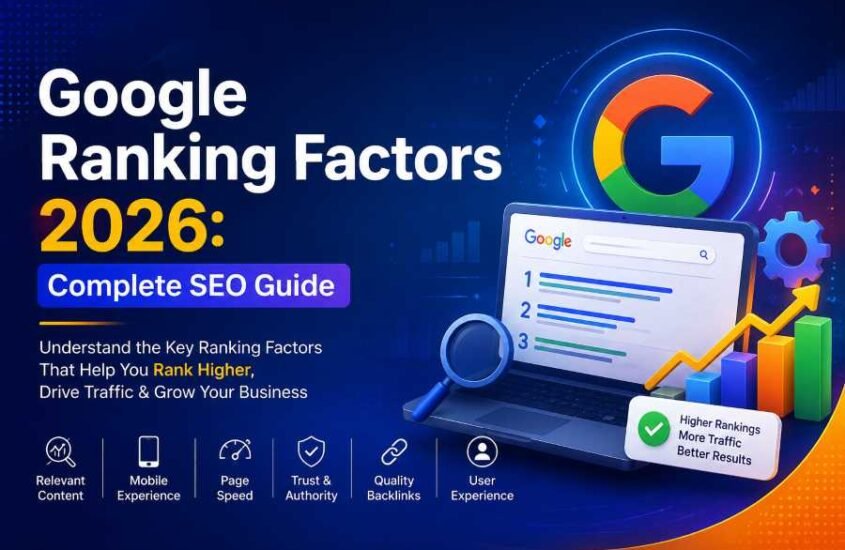
“200+ ranking factors” has become one of the most repeated numbers in SEO, and it’s technically true — but it’s also misleading. Google doesn’t run down a checklist and tally points. It uses layered systems: one set of models retrieves a pool of relevant pages, another re-ranks them using quality, authority, freshness, and experience signals, and separate systems like Helpful Content and SpamBrain filter or reweight results before they ever reach the search page. That’s why two pages targeting the same keyword can perform completely differently, even when both look “optimized” on paper. Rather than chasing a 200-item list, here’s a breakdown of the google ranking factors that genuinely carry weight in 2026, and how to prioritize them.
How Google Actually Ranks Pages in 2026
Think of ranking as three layers working together rather than one formula. First, Google retrieves a pool of pages that are topically relevant to a query, based on words, entities, and topic matching. Next, deeper systems re-rank that pool using quality, link authority, freshness, and page experience signals. Finally, filtering systems check for spam, unhelpful content, or manipulation before final results are shown. A page needs to hold up reasonably well across all three layers — excelling at one while ignoring the others rarely produces lasting results.
The Ranking Factors That Actually Matter
1. Search Intent and Relevance
This sits at the very top of the list. Google evaluates whether your page’s content, format, and depth genuinely match what a searcher expects to find, not just whether your target keyword appears on the page. If your content targets a keyword but doesn’t satisfy the intent behind it, Google will lower your visibility regardless of how well-optimized everything else is.
2. Content Quality and E-E-A-T
Google’s quality raters assess content through the lens of Experience, Expertise, Authoritativeness, and Trustworthiness. Sites that clearly demonstrate real experience and credible authorship, back up claims, and maintain accuracy tend to weather algorithm updates far more smoothly than sites relying on thin or generic content.
3. Page Experience and Core Web Vitals
Site performance is now a direct ranking signal, with some estimates suggesting Core Web Vitals account for roughly a quarter or more of overall ranking weight. But 2026 has expanded what “performance” means beyond raw speed — usability factors like layout stability, interaction responsiveness (INP), and freedom from intrusive design elements now weigh in alongside load time.
4. Backlinks — Quality Over Quantity
Backlinks remain a meaningful trust signal, and Google’s own leaked internal documentation confirms it scores site-wide link authority. That said, one senior Google representative has noted that links are no longer among the very top three ranking signals, a notable shift from their earlier dominance. The practical takeaway: a small number of genuinely relevant, authoritative backlinks now outperforms a large volume of low-quality ones, and digital PR has emerged as the most effective link-building tactic for 2026, ahead of guest posting and traditional outreach.
5. Topical Authority
Google increasingly favors websites that demonstrate clear subject matter depth across a topic, not just a single well-optimized page. Building content clusters that cover a subject comprehensively, with clear internal linking between related pages, signals genuine expertise rather than a one-off attempt to rank for a single keyword.
6. Technical SEO and Crawlability
None of the above matters if Google can’t properly crawl, render, and index your pages in the first place. A well-structured, technically sound website lets search engines access and understand your content without friction — technical issues can suppress rankings even for genuinely high-quality, well-linked pages.
7. Engagement Signals
Click-through rate, dwell time, scroll depth, and repeat visits all help Google gauge whether content is genuinely satisfying searchers or leaving them wanting more. Pages that keep visitors engaged, rather than prompting an immediate return to the search results, tend to hold their rankings more reliably over time.
8. Mobile-First Experience
Google primarily evaluates the mobile version of your website for ranking purposes. A confusing layout, slow load time, or poor usability on mobile devices will drag down rankings even if your desktop experience is excellent.
9. Content Freshness
For topics where recency matters, Google favors content that’s actively maintained and updated over stale pages, even if the older page originally ranked well. Regularly revisiting and updating cornerstone content tends to outperform a “publish and forget” approach.
10. Structured Data (Schema Markup)
Schema helps Google understand your content faster and more accurately, improving your chances of appearing in featured snippets and AI Overview citations. It’s increasingly a baseline expectation rather than a nice-to-have technical extra.
11. Local SEO Signals
For location-based searches, a well-optimized Google Business Profile, consistent citations, and genuine customer reviews play an outsized role in rankings, often mattering more than traditional on-page factors for local business queries.
What Doesn’t Matter as Much Anymore
- Exact-match keyword stuffing — natural, topic-driven writing now outperforms repeated keyword insertion.
- Raw backlink volume — a handful of relevant, authoritative links beats hundreds of low-quality ones.
- Publishing frequency for its own sake — content depth and genuine usefulness matter more than sheer output.
- Exact keyword density formulas — Google’s models now interpret meaning and entities, not just word matching.
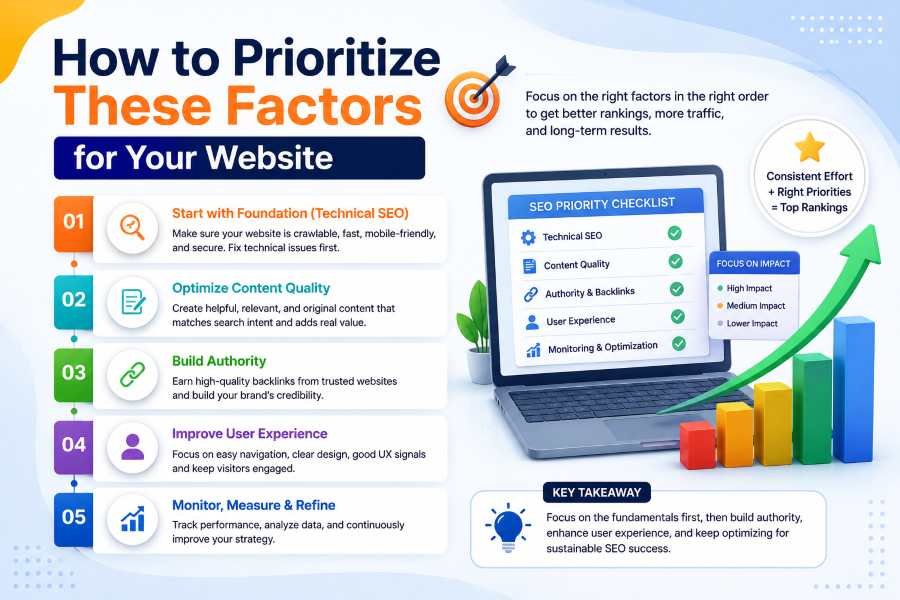
How to Prioritize These Factors for Your Website
With so many signals in play, trying to optimize everything at once is a recipe for spreading your effort too thin. Start with the three foundations that carry the most consistent weight: make sure your content genuinely satisfies search intent, that it’s high-quality and trustworthy enough to hold up under scrutiny, and that your site is fast, mobile-friendly, and easy for Google to crawl. Once those fundamentals are solid, layer in topical authority building, quality backlink acquisition, structured data, and engagement optimization — in that order, they tend to deliver the most reliable, lasting improvement in rankings.
How Do We Actually Know What Google Uses?
A fair question, given how much speculation circulates in SEO. Much of today’s clearer picture traces back to a significant 2024 leak of Google’s internal Content Warehouse API documentation, which exposed more than 14,000 internal attributes and finally let SEO professionals name what Google’s ranking systems appear to measure. Combined with Google’s own public statements, patent filings, and large-scale correlation studies from tools like Semrush and Backlinko, this gives a reasonably grounded (if still incomplete) picture of what matters — far more reliable than guesswork or outdated “200 factors” lists that treat every signal as equally weighted.
A Quick Note on AI Search
It’s worth flagging that traditional ranking factors don’t operate in isolation from AI-powered search anymore. A growing share of SEO professionals now believe backlinks and structured content also influence visibility inside AI Overviews and AI-generated answers, not just classic blue-link rankings. The practical implication: the same fundamentals covered here — genuine relevance, real authority, clean technical structure — are increasingly what determines whether your content gets surfaced by AI search systems too, even though the mechanics of AI visibility deserve their own deeper discussion beyond this guide.
Conclusion
Google ranking factors in 2026 aren’t a static checklist to tick off — they’re a set of interlocking systems that evaluate relevance, quality, authority, and experience together. Chasing any single factor in isolation, whether that’s backlinks, keyword density, or page speed alone, rarely produces lasting results anymore. The websites performing best right now are the ones that consistently nail search intent and content quality, back it up with real technical soundness, and build authority the slow, legitimate way. That combination isn’t flashy, but it’s what actually holds up through algorithm updates.
Frequently Asked Questions (FAQs)
Q1. What is the single most important Google ranking factor in 2026?
Search intent and content relevance sit at the top. Google’s systems evaluate whether a page’s content, format, and depth actually match what a searcher is looking for, and if that match is off, no amount of technical optimization elsewhere will compensate for it.
Q2. Do backlinks still matter for SEO in 2026?
Yes, but quality and contextual relevance matter far more than raw quantity. Google’s own leaked ranking documentation confirms it scores site-wide link authority, though a Google representative has noted links are no longer among the very top three signals, down from their historical dominance. A handful of relevant, authoritative backlinks outperforms a large volume of low-quality ones.
Q3. How much do Core Web Vitals actually affect rankings?
Page experience and Core Web Vitals are estimated to account for a meaningful share of overall ranking weight in 2026, making site performance a direct signal rather than just a tiebreaker. Beyond raw speed, Google increasingly evaluates usability factors like layout stability, interaction responsiveness, and mobile functionality.
Q4. What is E-E-A-T and why does it matter for rankings?
E-E-A-T stands for Experience, Expertise, Authoritativeness, and Trustworthiness — the framework Google’s quality raters use to assess content credibility. While E-E-A-T itself isn’t a single direct ranking factor, it strongly influences the underlying signals Google’s algorithms do use, and sites that clearly demonstrate it tend to perform more consistently through algorithm updates.
Q5. Is keyword stuffing still an effective SEO tactic?
No. Google’s ranking systems no longer reward exact-phrase matching or keyword density; instead, they prioritize relevance, user satisfaction, authority, and engagement. Content written naturally around a topic, with clear structure and genuine depth, consistently outperforms content stuffed with repeated keywords.
Q6. How should I prioritize my SEO efforts given so many ranking factors?
Start with the fundamentals that carry the most weight: make sure your content clearly satisfies search intent, is genuinely high-quality and trustworthy, and that your site is fast, mobile-friendly, and easy for Google to crawl and index. Once those three foundations are solid, layer in backlink building, structured data, and engagement optimization.
Thank you for reading
Buy Web Hosting at an affordable price: Buy Now.
If you want to build your website at an affordable price, contact www.nextr.in
Read this: How AI is Changing Education