Agentic AI, Edge Computing & the Chip Race Reshaping the Industry
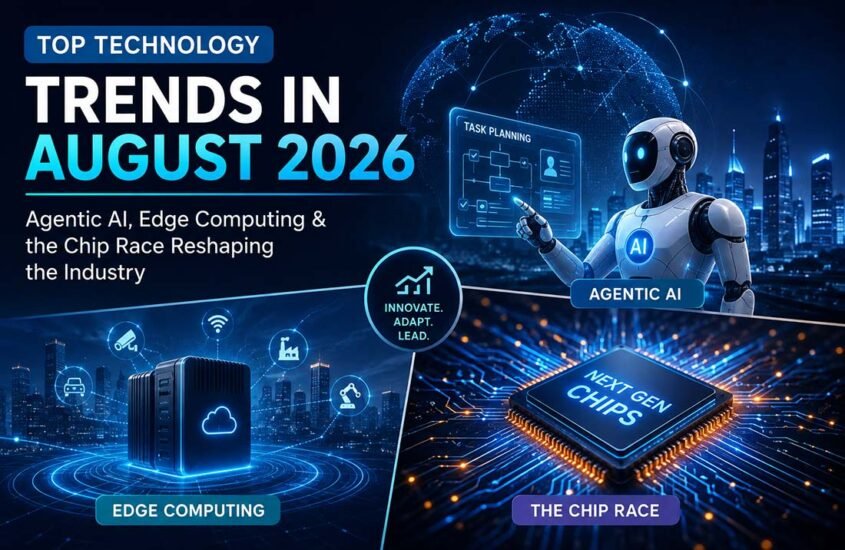
Technology in 2026 isn’t just moving fast; it’s moving in leaps. What started a few years ago as chatbots that could draft an email or generate a decent image has evolved into AI systems that reason through complex problems, run physical robots in warehouses, and operate entirely on-device without needing a cloud connection. At the same time, the infrastructure behind all this intelligence- chips, data centres, energy, and cooling- has become just as newsworthy as the models themselves.
If you run a business, work in tech, or simply want to stay ahead of the curve, here’s a breakdown of the biggest technology trends making headlines in 2026, and what they actually mean for you.
The latest tech news and innovation trends every business and tech enthusiast should know
1. Agentic AI Is the New Multimodal
If 2024 was the year of multimodal AI, models that could see, hear, and generate across formats, 2026 is the year of agentic reasoning. Instead of simply responding to prompts, today’s leading AI systems can plan multi-step tasks, use external tools, verify their own outputs, and carry out entire workflows with minimal human input.
Coding assistants are a good example of this shift. New AI-powered development platforms can now write code, catch bugs, automatically verify results, and manage complex software projects end-to-end, rather than just autocompleting a function. For businesses, this means AI is moving from a productivity add-on to something closer to a digital teammate that can own a task from start to finish.
2. Open, Local Models Are Challenging Cloud Giants
One of the more surprising shifts in 2026 is how much AI capability is now available outside massive cloud data centres. Large technology companies have released powerful open models with tens of billions of parameters that can run on a single GPU, putting serious AI capability within reach of smaller companies and independent developers, not just hyperscalers.
This democratisation matters because it lowers the barrier to entry. A growing number of businesses no longer need to depend entirely on expensive API calls to a handful of major providers; they can run capable models locally, which also improves data privacy and reduces latency.
3. Edge AI: Intelligence Without the Cloud
Edge computing has quietly become one of the most important trends of the year. Rather than sending data back and forth to remote servers, more AI processing is now happening directly on personal devices, wearables, and industrial hardware. This shift toward Edge AI is delivering faster response times, stronger privacy since data doesn’t need to leave the device, and more reliable performance in areas with limited connectivity.
For everyday users, this translates into smarter phones, smarter cars, and smarter home devices that work seamlessly even without a stable internet connection. For businesses, it opens the door to real-time AI applications in manufacturing, logistics, and healthcare, where a delay of even a second or two can matter.
4. The Global Chip Race Is Intensifying
Behind every AI headline is a much bigger story: semiconductors. Demand for advanced chips continues to climb sharply, and major foundries have reported strong sales growth as AI workloads scale up. Countries and companies are pouring billions into chip manufacturing and supply chain security, treating semiconductor capacity as a matter of national strategic importance, not just a business decision.
This has real consequences beyond the tech industry. Memory chip shortages are already triggering supply pressure, and governments are actively lobbying and legislating to secure their share of global chip production. If you’re in hardware, electronics, or any industry that depends on chip-powered devices, this is a trend worth watching closely through the rest of the year.
5. Data Centres Get a Cooling Makeover
As AI models grow larger and more power-hungry, the infrastructure supporting them is evolving too. Traditional water-based cooling is increasingly being replaced by immersion cooling, where computer chips are submerged directly in non-conductive engineered fluids. This approach has meaningfully cut the energy required for cooling, addressing one of the biggest sustainability concerns tied to AI’s rapid growth.
For investors and business leaders, this signals that the “AI supply chain” is no longer just about buying chips. It now includes energy infrastructure, cooling technology, and edge hardware, an ecosystem that’s becoming just as strategically important as the models themselves.
6. AI Regulation Is Finally Taking Shape
After years of a fairly chaotic legal and ethical landscape, 2026 is the year regulatory frameworks are starting to catch up with the technology. Major regulations, including strict enforcement of comprehensive AI legislation in Europe, are now in force, pushing companies to build compliance, transparency, and accountability directly into how they develop and deploy AI systems.
For businesses operating across regions, this means AI governance can no longer be an afterthought. Data handling, model transparency, and risk assessment are becoming standard parts of any serious AI rollout, not optional extras.
7. Cybersecurity Risks Are Scaling With AI
As AI capabilities grow, so do the risks. Cybercriminals are increasingly using AI to automate phishing campaigns, generate convincing deepfakes, and create synthetic digital identities, making attacks faster, more targeted, and harder to detect. Financial regulators have also flagged growing concentration risk, since so many institutions now depend on the same handful of cloud and AI providers, meaning an outage or breach at one major vendor could ripple across an entire industry.
This makes cybersecurity one of the most urgent priorities for any organisation adopting AI at scale. Strong data governance, multi-vendor strategies, and proactive threat detection are quickly becoming non-negotiable rather than nice-to-have.
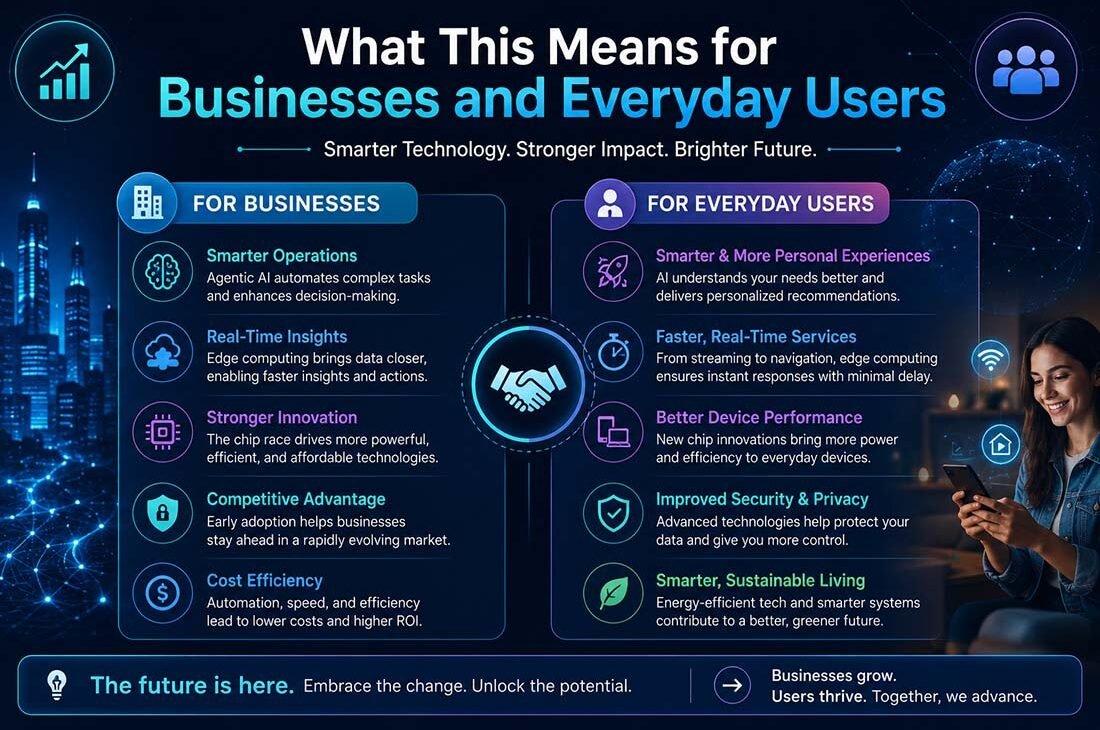
8. What This Means for Businesses and Everyday Users
Taken together, these trends point to a clear direction: AI is no longer confined to a browser tab or a chatbot window. It’s embedded in hardware, infrastructure, regulation, and security strategy across nearly every industry. The organisations that benefit most won’t necessarily be the ones chasing the flashiest new model release; they’ll be the ones that thoughtfully test AI on real workflows, track cost and accuracy, and keep data governance tight as they scale.
A few practical takeaways worth acting on right now:
● Run a small, time-boxed pilot on one repetitive task before committing to a full AI rollout.
● Compare at least two model or vendor options rather than locking into a single provider.
● Factor in data privacy and compliance requirements from day one, not after deployment.
● Keep an eye on edge AI tools if latency, privacy, or offline reliability matter for your use case.
● Treat cybersecurity training and monitoring as part of any AI adoption plan, not a separate initiative.
Conclusion
Technology in 2026 is being defined less by any single flashy announcement and more by how deeply AI is now woven into infrastructure, regulation, hardware, and security. From agentic AI systems that can complete entire workflows, to edge computing that brings intelligence closer to the user, to a global chip race reshaping supply chains, the pace of change shows no signs of slowing down.
For businesses and tech enthusiasts alike, staying informed isn’t optional anymore; it’s a competitive advantage. Keep following NextR Technology for the latest breakdowns of what’s changing in tech and what it actually means for you.
Frequently Asked Questions (FAQs)
Q1. What is agentic AI, and why is it a big trend in 2026?
Agentic AI refers to AI systems that can plan, execute, and verify multi-step tasks with minimal human input, rather than just responding to single prompts. It’s a major trend in 2026 because it allows AI to handle entire workflows, like coding or research, more independently.
Q2. What is Edge AI and how is it different from cloud-based AI?
Edge AI processes data directly on a device, like a phone or a car, instead of sending it to a remote server. This makes it faster, more private, and more reliable in areas with limited internet connectivity compared to traditional cloud-based AI.
Q3. Why is the global chip shortage still a major topic in 2026?
Demand for advanced semiconductors keeps rising as AI workloads scale up, putting pressure on global supply chains. Governments and companies are investing heavily in chip manufacturing, making semiconductor capacity a strategic priority, not just a business concern.
Q4. How is AI regulation affecting businesses in 2026?
With major regulatory frameworks, including strict AI legislation in Europe, now in force, businesses need to build compliance, transparency, and data governance directly into their AI systems rather than treating regulation as an afterthought.
Q5. What cybersecurity risks come with growing AI adoption?
AI is making cyberattacks like phishing and deepfakes faster and harder to detect. There’s also growing concentration risk, since many organisations depend on the same few cloud and AI providers, which can amplify the impact of a single outage or breach.
Q6. How can a business start adopting AI responsibly in 2026?
Start with a small pilot on one specific task, compare multiple model or vendor options, prioritise data privacy and compliance from the outset, and build cybersecurity monitoring into the rollout from day one rather than adding it later.
Thank you for reading
Buy Web Hosting at an affordable price: Buy Now.
If you want to build your website at an affordable price, contact www.nextr.in
Read this: How AI is Changing Education
Published on NextR Technology — your source for the latest technology news, AI updates, and industry trends.