SEO & Digital Marketing Trends 2026: How AI Search, GEO, and AEO Are Rewriting the Rules
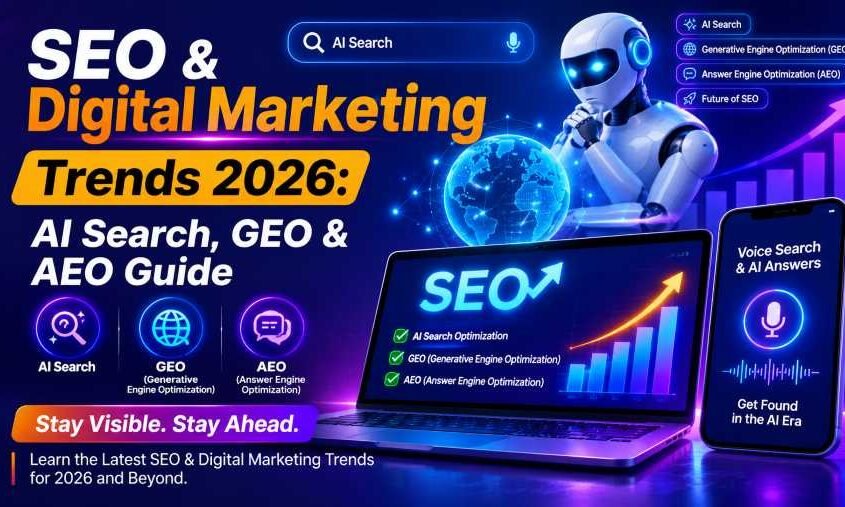
If your SEO strategy still looks exactly like it did in 2023, it’s time for an update. Search in 2026 doesn’t just return ten blue links anymore — it hands users a synthesized AI answer before they scroll past the fold, often pulled from multiple sources and displayed without a single click required. For businesses that depend on organic visibility to generate leads, this shift isn’t a minor algorithm tweak. It’s a fundamental change in how people discover brands online, and it’s forcing marketers to rethink strategies that have worked for over two decades.
Here’s a practical look at the SEO and digital marketing trends actually shaping results in 2026, and what businesses need to do about them.
Why 2026 Is a Turning Point for SEO
The numbers tell the story clearly. Zero-click searches — where users get their answer directly on the results page without visiting any website — now account for more than half of all Google searches. Google’s AI Overviews have expanded dramatically too, now appearing across a substantial majority of queries, up sharply from their early rollout just a couple of years ago. For pages that rank in position one, click-through rates on queries with an AI Overview present have dropped significantly compared to standard results.
The practical takeaway isn’t that SEO is dying — it’s that ranking #1 is no longer the finish line it used to be. Visibility now needs to be measured across AI-generated answers, featured snippets, and multiple search surfaces, not just a position on a results page.
The Rise of Generative Engine Optimization (GEO)
Generative Engine Optimization has emerged as one of the defining disciplines of 2026. Where traditional SEO optimizes a page to rank in a list, GEO optimizes content to be understood, trusted, and cited by AI systems like Google AI Overviews, ChatGPT Search, and Perplexity when they generate an answer. Being referenced inside an AI-generated response is increasingly described by marketers as the “new visibility currency” — even without a click, appearing as a cited source builds brand recognition and trust.
Winning at GEO typically means building genuine topical authority (comprehensive coverage of a subject rather than one-off blog posts), earning authoritative mentions through digital PR, and structuring content so AI systems can easily extract clear, accurate information from it.
Answer Engine Optimization (AEO): Earning a Spot in AI Overviews
Closely related to GEO, Answer Engine Optimization focuses specifically on getting your content selected as the direct answer shown in AI Overviews, featured snippets, and voice search results. Content that tends to get pulled into these AI-generated summaries shares a few common traits: clean H1–H3 heading structure, concise and direct answers to specific questions, bullet points and definitions that are easy to extract, and comprehensive coverage that avoids forcing the AI to guess at missing context. Structured data markup (schema) also continues to play an important supporting role, helping search engines and AI systems understand exactly what a page is about.
E-E-A-T Matters More Than Ever
Experience, Expertise, Authoritativeness, and Trustworthiness — E-E-A-T — has become a critical trust filter, not just for Google’s classic ranking algorithm but for the AI systems deciding which sources are reliable enough to cite. Websites that demonstrate genuine, first-hand expertise, transparent authorship, and consistent brand signals across the web are proving far more resilient to algorithm changes than sites relying on generic or purely AI-generated content. In practice, this means real case studies, named authors with credentials, and honest, specific detail win out over vague, keyword-stuffed pages.
Search Everywhere Optimization: Life Beyond Google
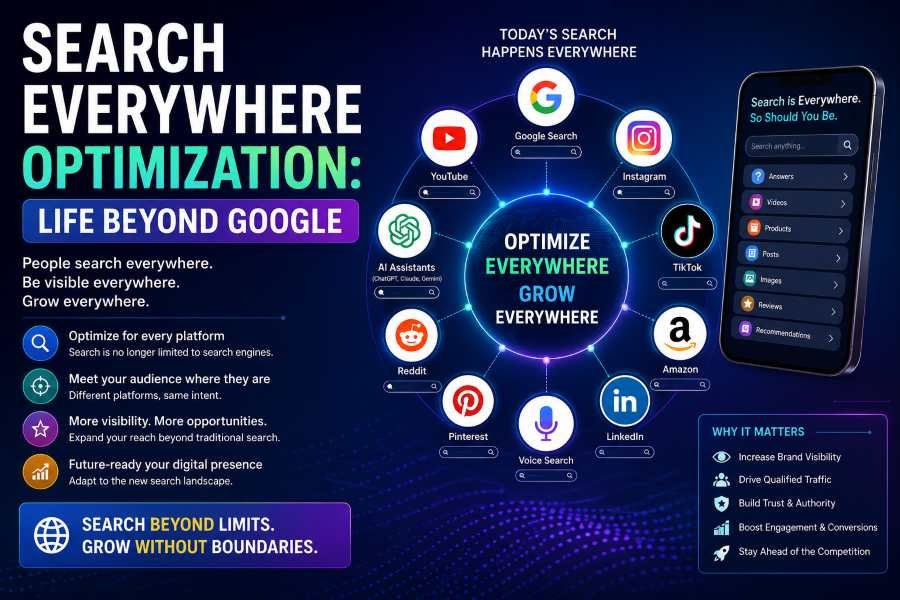
Search discovery in 2026 no longer starts and ends on Google. Consumers are increasingly researching products and services on ChatGPT Search, Perplexity, YouTube, TikTok, and Amazon, treating each as a legitimate search destination in its own right. This has given rise to what many marketers now call “Search Everywhere Optimization” — a strategy that treats visibility as something to build across every platform a customer might use to search, not just the traditional Google results page. For brands, that means content, reviews, and social presence increasingly need to work together as one connected visibility strategy rather than separate, siloed efforts.
AI Is Also Changing How Content Gets Made
It’s not just search that’s changed — content production itself has shifted. The vast majority of SEO professionals now report using AI somewhere in their content workflow, primarily for research, outlining, and first drafts. But the marketers seeing the best results aren’t simply publishing AI output as-is; the overwhelming majority still review AI-generated content by hand before it goes live. The winning formula that’s emerged in 2026 is a hybrid model: let AI handle the heavy lifting of research and drafting, and let human expertise add the insight, nuance, and real-world experience that both readers and AI systems are increasingly trained to reward.
What Still Works: The SEO Fundamentals That Haven’t Changed
- Commercial and transactional searches, where users are comparing providers or ready to buy, still send meaningful traffic to top-ranking organic results.
- Fast page speed, mobile responsiveness, and clean technical SEO remain foundational — AI systems and traditional rankings both reward well-built websites.
- A well-maintained Google Business Profile continues to matter enormously for local and service-based businesses.
- Genuine topical depth and comprehensive content clusters continue to outperform isolated, thin blog posts.
Measuring Success Looks Different Now
Traditional SEO reporting leaned heavily on keyword rankings and organic click volume, but those metrics alone no longer capture the full picture in 2026. A page can be cited prominently inside an AI Overview and influence a buying decision without ever registering a click in analytics. Forward-looking marketing teams are now tracking a broader set of signals: how often a brand is mentioned or cited in AI-generated answers, branded search volume (a strong indicator that AI visibility is building brand recall), and conversion quality from the traffic that does arrive, since visitors referred from AI Overviews tend to arrive further along in their decision-making process. Attribution is harder in this environment, but it’s also more honest about how discovery actually works today.
Practical Next Steps for Businesses in 2026
Businesses don’t need to overhaul everything overnight. A sensible starting point is auditing existing content for clarity and structure, adding schema markup where it’s missing, and identifying which high-intent pages should be optimized for both traditional ranking and AI-answer visibility. Investing in digital PR and authentic expert content helps build the authority signals that both search engines and AI systems increasingly rely on. Finally, tracking AI Overview and AI-answer visibility alongside traditional keyword rankings is quickly becoming a standard part of measuring digital marketing performance, not an optional add-on.
- Audit top-performing pages and restructure them with clear headers, direct answers, and scannable formatting.
- Add or refresh schema markup (FAQ, Article, Organization) so search engines can parse content accurately.
- Build topic clusters around core services instead of publishing isolated, one-off blog posts.
- Pursue digital PR and expert-authored content to strengthen brand authority signals across the web.
- Start tracking AI Overview appearances and branded search volume alongside traditional rank-tracking tools.
Conclusion
SEO in 2026 hasn’t disappeared — it’s expanded. Between AI Overviews, zero-click search, Generative Engine Optimization, and Answer Engine Optimization, the discipline now covers far more ground than simply chasing a #1 ranking. Brands that combine strong technical SEO fundamentals with genuine expertise, structured content, and visibility across AI-driven search surfaces are the ones best positioned to stay discoverable, no matter how search continues to evolve. The businesses that treat this as an opportunity to build real authority — rather than a threat to old tactics — are the ones set to come out ahead.
Frequently Asked Questions (FAQs)
Q1. What is Generative Engine Optimization (GEO)?
GEO is the practice of optimizing content so that it gets referenced, cited, or summarized by AI-powered answer engines such as Google AI Overviews, ChatGPT Search, and Perplexity, rather than optimizing purely for a ranked list of blue links. It focuses on structured, citation-worthy, authoritative content that AI systems can confidently pull from.
Q2. How is AEO different from traditional SEO?
Answer Engine Optimization (AEO) focuses specifically on getting content selected as the direct answer inside AI Overviews, featured snippets, and voice search results, using clear formatting, concise definitions, and structured data. Traditional SEO focuses more broadly on ranking a page in the organic results list. In 2026, most businesses need both working together.
Q3. Is SEO still worth investing in with the rise of AI search?
Yes. While zero-click search and AI Overviews have reduced clicks for many informational queries, commercial and transactional searches — where users compare options or intend to buy — still send significant traffic to top organic results. Smart businesses are expanding their strategy to cover both traditional rankings and AI visibility rather than abandoning SEO.
Q4. What is zero-click search and why does it matter?
Zero-click search refers to searches where the user gets their answer directly on the results page — through an AI Overview, featured snippet, or knowledge panel — without clicking through to any website. With more than half of Google searches now ending this way, brands need to focus on being visible and cited within the results page itself, not just on driving clicks.
Q5. Do I still need quality content if AI is writing more of it?
Yes, arguably more than ever. Search engines and AI systems increasingly reward content with genuine expertise, first-hand experience, and clear authority signals (E-E-A-T) over generic AI-generated text. The most effective approach in 2026 is using AI to speed up research and drafting while relying on human expertise for insight, accuracy, and final review.
Q6. How can a small or local business start adapting to these SEO changes?
Start with the fundamentals that still matter most: fast, mobile-friendly website performance, clear and well-structured content that directly answers customer questions, an active Google Business Profile, and consistent brand mentions across the web. From there, businesses can layer in structured data and AI-visibility tracking as their digital marketing strategy matures.
Thank you for reading
Buy Web Hosting at an affordable price: Buy Now.
If you want to build your website at an affordable price, contact www.nextr.in
Read this: How AI is Changing Education