AI in Software Development: How AI Agents Are Transforming Coding in 2026
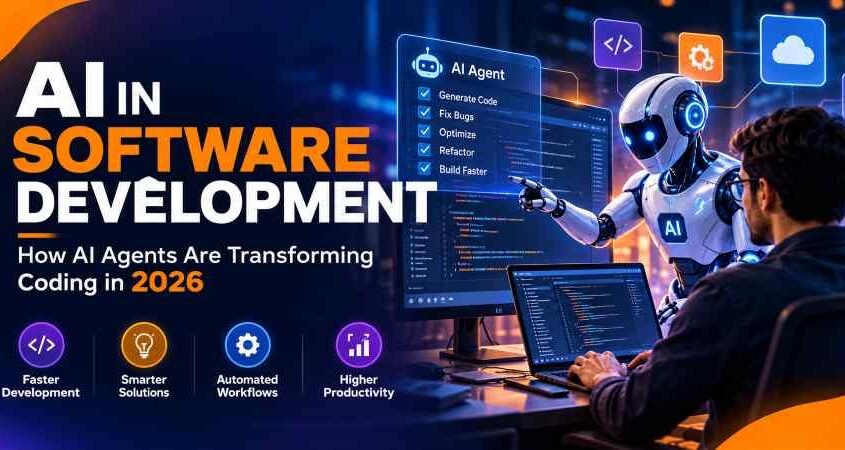
The software development industry is stepping into an era in 2026 driven by artificial intelligence, automation and intelligent coding systems.
One of the important emerging trends is Agentic AI in Software Development, which allows AI agents to perform complex development tasks with greater independence.
Unlike AI coding assistants that primarily suggest code or answer programming questions AI agents can plan tasks generate code identify bugs execute tests and improve solutions based on feedback. With instructions, tools and permissions Agentic AI systems can manage multiple stages of the software development process while developers maintain control over critical decisions.
Businesses are increasingly exploring Agentic AI to accelerate application development improve engineering workflows and reduce manual work. From startups building products to enterprises maintaining complex software systems AI‑powered development offers new opportunities to improve productivity and operational efficiency. However successful adoption requires supervision, secure infrastructure and reliable quality checks. Understanding how Agentic AI works and how it is transforming coding can help businesses make decisions about their software development strategies in 2026.
What Is Agentic AI in Software Development and How Does It Work?
Agentic AI in software development refers to intelligence systems that can pursue defined objectives by planning tasks using available tools taking actions and evaluating results. Than responding to a single instruction with a code suggestion Agentic AI can work through a sequence of related activities to accomplish a development goal. For example when asked to create a user registration feature Agentic AI may examine the existing codebase identify the components implement the required functionality, write tests and suggest fixes when errors occur.
The process generally begins with a developer defining the objective and providing the project context. Agentic AI then breaks the objective into tasks determines an appropriate approach and uses connected development tools to complete the work. Depending on its configuration Agentic AI may interact with code repositories, testing environments, documentation, APIs and command‑line tools. Agentic AI can evaluate the results of its actions. Revise its approach when a test fails or an implementation does not meet the specified requirements.
A major difference between AI coding assistants and Agentic AI systems is Agentic AI ability to coordinate multi‑step workflows. Traditional assistants are often used for code completion, explanations and individual programming tasks. Agentic AI systems can connect these activities into a process although Agentic AI capabilities vary by tool, model and level of access. Human developers remain responsible for defining requirements reviewing decisions validating outputs and approving sensitive changes.
In 2026 Agentic AI agents and multi‑agent workflows are attracting attention because they can support stages of the software development lifecycle. Some workflows use agents for coding, testing, documentation and code review. Agentic AI agents may work sequentially or in parallel with a coordinating system combining their outputs. This approach can help development teams manage projects more efficiently when tasks are clearly defined and the underlying tools are properly configured.
Key Benefits of AI Agents for Coding, Testing and Software Development
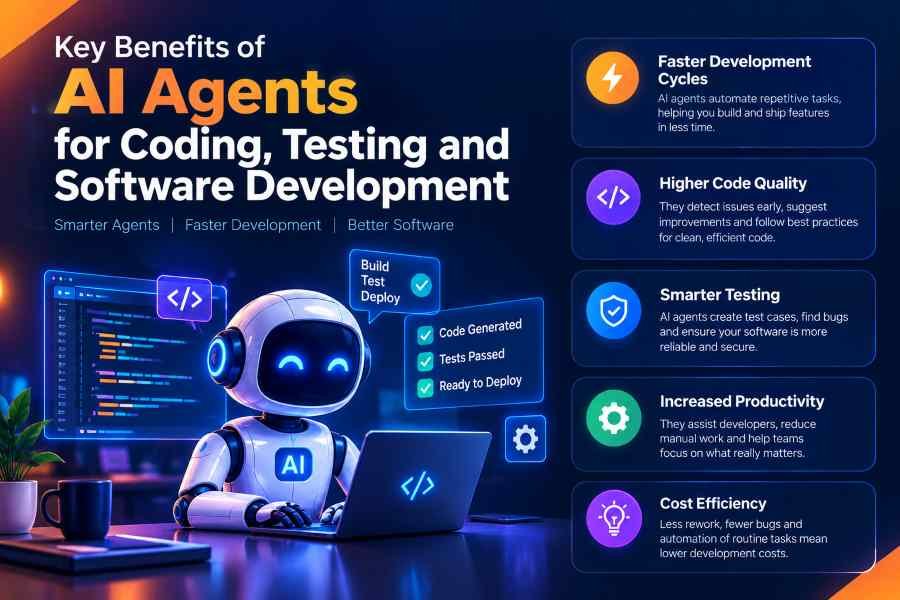
One of the advantages of Agentic AI for coding is Agentic AI potential to reduce the time spent on repetitive programming activities. Developers can delegate tasks, such as generating routine code preparing test cases updating documentation and investigating common errors. This allows engineering teams to dedicate attention to system architecture, business requirements, user experience and complex technical challenges. Actual productivity improvements depend on the task, the quality of the Agentic AI output and the amount of review required.
Automated software testing is another application. Agentic AI can help generate test scenarios execute existing test suites, analyze failures and recommend changes to address identified problems. When integrated into a controlled development workflow Agentic AI capabilities can shorten feedback cycles. Help teams discover defects earlier. However Agentic AI‑generated tests should be reviewed to ensure they cover edge cases and accurately represent expected application behavior.
Agentic AI can also support debugging and code maintenance. When a software application encounters an error Agentic AI may inspect logs, trace potential causes examine related code and propose a fix. Developers can then review the suggested changes. Validate them in a test environment before deployment. This process may be particularly useful, for projects where investigating interconnected components can require considerable effort.
Another benefit is automation of development workflows. Agentic AI can help with code reviews preparing pull requests writing documentation analyzing dependencies and carrying out routine maintenance. When Agentic AI is linked to approved project management and development tools it can organize tasks. Cut down on unnecessary manual handoffs between stages. Multi‑agent systems can also split parts of a project among specialist agents as long as dependencies and shared resources are handled carefully.
For businesses these capabilities support prototyping, steadier development processes and better use of resources. Startups can use Agentic AI‑assisted workflows to test product ideas quickly while larger companies may try automation for repetitive engineering tasks. Companies looking for software development services can gain by checking where Agentic AI methods fit their particular business needs.
Nevertheless Agentic AI‑generated code is not automatically secure, accurate or ready for production. Agentic AI may add bugs misinterpret requirements or suggest solutions. Agentic AI works best when the project context is suitable instructions are clear automated checks are in place and experienced humans review the work. Businesses should gauge improvements by looking at indicators such as delivery time, defect rates, code quality, maintenance effort and total development costs not just by assuming that automation always yields better results.
Challenges, Security Considerations and the Future of Agentic AI Development in 2026
Despite its promise Agentic AI brings challenges that businesses must tackle before using it throughout their software development work. Security is a worry because Agentic AI may need access to source code, development environments, databases, APIs or other sensitive resources. Many permissions can raise the risk of mistakes or unauthorized actions. Organizations should therefore follow the principle of privilege use isolated execution environments when possible safeguard credentials and limit access to sensitive systems.
Code quality and reliability are equally vital. Agentic AI may produce code that looks correct but hides errors, security gaps or compatibility problems. Every major change must go through automated tests, code analysis and human review. Production deployments, database migrations changes to access controls and other high‑impact operations should gain approval and follow set release procedures.
Another challenge is keeping control over workflows. When several Agentic AI units work on a shared project they may create changes, duplicate effort or make inconsistent architecture choices. Development teams need task boundaries, version control, traceable changes and dependable coordination methods. They should also keep audit logs. Watch Agentic AI activity so that unexpected behavior can be examined.
The future of AI in software development will probably mean deeper integration with development environments, continuous integration and continuous delivery pipelines, cloud infrastructure and enterprise software platforms. Agentic AI may increasingly help teams progress from requirements to implementation, testing, documentation and maintenance using linked workflows. Multi‑agent collaboration could also become more valuable for projects that split into well‑defined tasks.
At the time developers will still have a vital role in software engineering. Their duties may grow to include designing systems setting technical limits reviewing Agentic AI changes, managing risks and making sure software satisfies business and user needs. Skills like system design, critical thinking, security awareness and AI workflow management will stay important.
Businesses thinking about this technology should start with low‑risk use cases set measurable performance goals and grow slowly as reliability grows. By mixing AI automation with seasoned engineering teams and solid governance organizations can try the perks of Agentic AI development without hurting software quality or security.
Conclusion
Agentic AI in software development is becoming a technology trend in 2026 giving new ways to automate coding, testing, debugging, documentation and maintenance. By managing multi‑step tasks Agentic AI can help developers boost workflow efficiency and focus on tougher engineering choices. Yet success relies on tool access, trustworthy testing, clear instructions and human oversight.
For businesses planning their digital product adopting Agentic AI should be a thoughtful choice that considers project needs, technical depth and measurable results. Combining automation with proven software engineering methods can help companies build scalable, maintainable and dependable applications.
As a technology partner, Nextr Technology can guide companies in exploring modern software development approaches and spotting solutions that match their digital transformation ambitions.
Frequently Asked Questions (FAQs)
What is AI, in software development?
Agentic AI in software development uses AI systems that can plan and execute multi-step tasks, such as generating code, running tests, investigating bugs, and preparing documentation, with varying levels of autonomy and human supervision.
How are AI agents changing software development in 2026?
I see that AI agents help developers automate coding tasks speed up testing look into errors and coordinate development workflows. The effectiveness of AI agents depends on the tools used on how complex the task’s on the quality‑control processes in place.
Can AI agents develop a software application?
I notice that AI agents can assist stages of application development and can produce large parts of an application. Yet I also see that complex projects still need guidance, architectural planning, security reviews, testing and deployment oversight.
Are AI coding agents safe for business software development?
I see that AI coding agents can be used safely when organizations apply restricted permissions, secure development environments, code reviews, automated testing and human approval for sensitive operations. I also see that AI coding agents should not be trusted with access to critical systems.
What is the future of AI in software engineering?
I believe the future may include coordinated AI agents, deeper integration with development tools and increased automation, across coding, testing and maintenance. I also believe that human developers will remain important for system design, validation, security and strategic decision‑making.
Thank you for reading
Buy Latest Tech Gadgets and Laptops: Click Here
Buy Web Hosting at an affordable price: Buy Now.
If you want to build your website at an affordable price, contact www.nextrtechnology.com
If you want to build your website at an affordable price, contact www.nextrtechnology.com
Read more blogs: https://www.nextrtechnology.com/blog/